As of April 2024, BESTSELLER partners with approximately 700 businesses across the world who manufacture products for BESTSELLER brands. To be transparent about our supply chain, BESTSELLER publishes its public factory list once every two months.

We work with numerous stakeholders to collaborate on managing our human rights, environmental and chemical risks in BESTSELLER's supply chain.

OUR TOP SOURCING COUNTRIES

by number of tier 1 factories
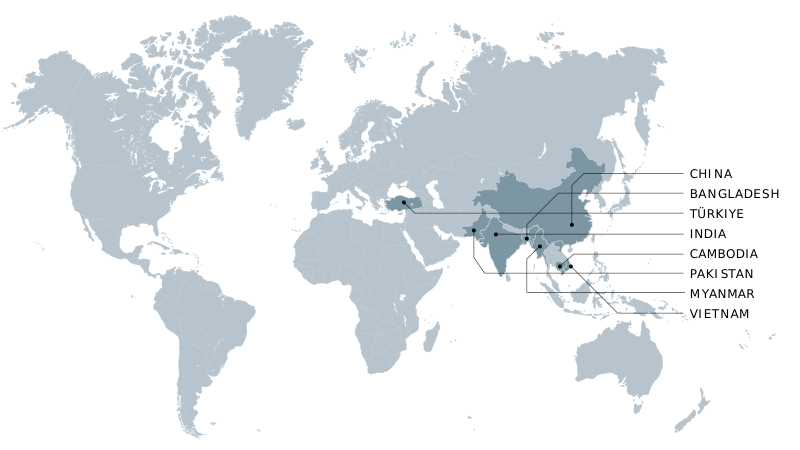
We are responsible for managing and mitigating risks in our supply chain. We develop and enforce standards of conduct to ensure our suppliers and their factories operate in accordance with relevant standards. 

We manage and maintain the Factory Standards Programme, which is our primary tool for holding suppliers and factories accountable to our requirements, but also describes how we work together to create improvements where needed. 

Click below to learn more about our general supply chain management.

Through our supply chain policies, we seek to uphold the principles of good governance and social and environmental stewardship. 

Our Social & Labour Requirements are designed to address the identified salient risks among our tier 0, 1 and 2 supply chain production units. Our assessment therefore covers over 150 indicators of risk during on-site visits.

Data from each factory assessment is fed into our internal information systems, as the basis for our Social & Labour Factory Rating, which is provided to other business functions, including buying teams, to help brands make informed purchasing decisions. 

We adopt a consistent and holistic approach to supply chain management. We assess human rights risks, focusing on issues like forced labour, health and safety, gender-based violence, discrimination, labour rights, freedom of association, and migrant labour. 

We identify and monitor environmental risks in our supply chain and use the insights from independent specialist consultants to upgrade our factory assessment methodology, policies, and environmental risk mitigation work going forward. And we measure performance through our Supplier Environment Rating and focus on environmental impact initiatives where they can make a difference.

Where a factory’s assessment reports show room for improvement, a Corrective Action Plan (CAP) is created, and our local colleagues visit the factories and provide them with guidance and training to make sure the necessary improvements are made and implemented according to the CAP.
The jury recognises our commitment in Direct-to-farm, a multi-stakeholder initiative that ensures responsible farming and trade of one of the fashion industry's essential raw materials; organic cotton
The International Accord for Health and Safety in the Textile and Garment Industry in Pakistan and Bangladesh has been renewed for six more years – the longest term yet.
Securing health and safety through multistakeholder collaboration.
The world’s four largest women’s empowerment programmes in the fashion industry have joined together to launch RISE, an initiative working to make it easier and more efficient to drive lasting impact on gender equality.
BESTSELLER joins leading fashion brands in affirming its commitment to the International Accord for Health and Safety in the Textile and Garment Industry in Pakistan.
In the past ten months, a window of wider possibilities has opened for more than a thousand women working in BESTSELLER's supply chain in Turkey. The women joined the first women empowerment programme initiated by BESTSELLER at four long-standing Turkish suppliers.
In almost 100 pages, we unfold our latest steps in the right direction.
BESTSELLER has signed a new agreement to develop a women empowerment programme for our suppliers in Turkey, building on the success of reaching the Fashion FWD target of empowering 100,000 women four years ahead of schedule.
Our Supply chain